


Hi there! How can we help you today?
Top 10 SEO Strategies Every Business Must Use in 2026
Discover the top 10 SEO strategies every business must use in 2026 to improve rankings, drive traffic, and grow online visibility.
Top 10 SEO Strategies Every Business Must Use in 2026
The Search Engine Optimization in 2026 is not what it was even two years ago. If you are still thinking in terms of keywords + backlinks = rankings you are already behind. You are just incomplete about new SEO Strategies. Because now the search experience has changed. Now users do not click the blue links on google anymore . They analyze the Ai overview data and get the data according to their requirements.
And that’s the whole game now:
Give people a reason to stay, trust, and come back.
SEO used to focus on search engines. Now it is about search experience.
Meaning:
- how quickly users find answers
- how clearly your content delivers value
- how easily they trust what they’re reading
If your content creates friction—confusing structure, vague writing, slow load—it doesn’t matter how optimized it is. Businesses that want to stay ahead often rely on a best SEO marketing company to adapt to these changes effectively.
Top 10 Seo Strategies as follow below:-
1. Search Intent Is the Foundation (Not Keywords)
Most people still start with keywords. That is the mistake.In 2026, Google does not just match words. It matches intent layers:
- Informational (what is…)
- Comparative (best tools…)
- Transactional (buy now…)
- Experiential (real reviews…)
If your page does not align with intent, it would not rank. Even if your SEO is perfect.
What works now:
- Break one keyword into multiple intents
- Create content that solves the full journey , not just one query
- Answer follow-up questions before users ask them
Example:
Instead of just best SEO tools, include:
- comparisons
- use cases
- pricing breakdown
- real pros/cons
That’s how you win featured snippets and AI overviews.
2.Use Proper Infographic and quality image in Content
Sometimes blog posts fail this is not because of the bad quality content. This fails due to using bad quality images in the blog . Due to a shortage of time, users do not want to read a full blog . They just check the visual content and they want to understand quickly.
Where to Use Infographics in a Blog
Don’t just add visuals randomly. Place them where they actually help.
Good spots:
- after explaining a process
- when comparing options
- summarizing long sections
- breaking down data
Bad spots:
- at the top just for decoration
- repeating what’s already obvious
- stuffing too many visuals in one section
Too many images can slow your site. And yes, that hurts SEO.
Balance matters.
3. Build Content That Actually Deserves to Rank
Publishing random blogs does not build authority anymore.Google wants to see depth. Consistency. Structure.You need content clusters, not isolated posts.
What that looks like:
- One main pillar page (e.g., SEO Strategies 2026)
- Supporting articles (technical SEO, AI SEO, backlinks, etc.)
- Internal linking that actually makes sense
Truth is, one strong topic covered deeply beats 50 scattered posts.And yes it takes time. But that is the main point.
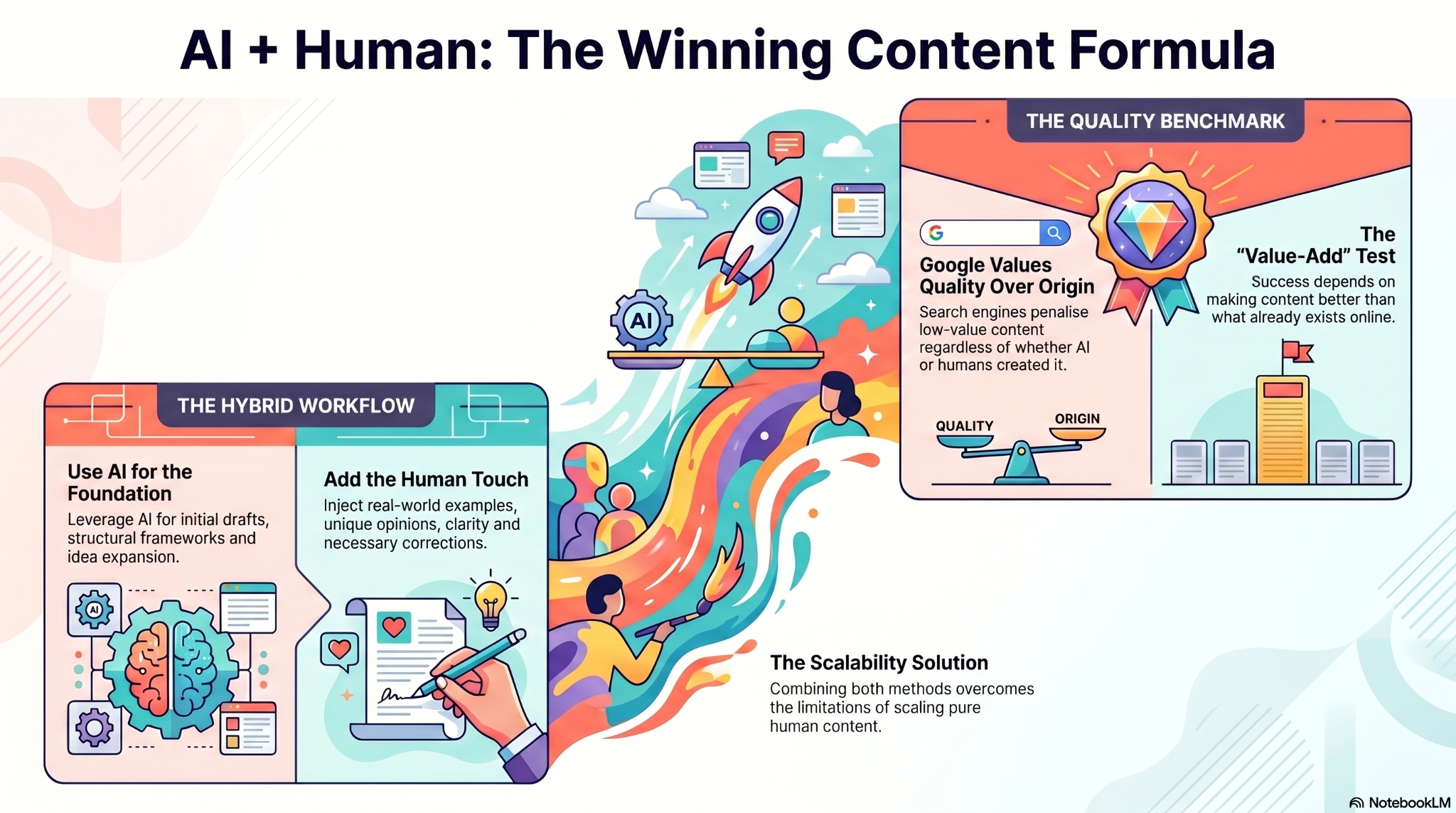
4. AI + Human Content Is the Winning Combo
AI content alone? Does it not cut it.Pure human content? Hard to scale.
The middle ground wins.
Use AI for:
- drafts
- structure
- idea expansion
But add human input for:
- real examples
- opinions
- clarity
- Corrections
Google is not against AI. It’s against low-value content.So the question is not AI or human?
It’s: Did you make it better than what already exists?
5. Optimize for AI Search
AI search results are stealing clicks. That is just reality.But they are also an opportunity.If your content is structured right, it gets featured inside AI answers .
How to optimize:
- Answer questions clearly (2–3 lines)
- Use bullet points where helpful
- Add structured headings (H2, H3 properly)
- Keep sections scannable
Think like this:
Your content should be easy to summarize.
Because that is literally what AI does.
6. Technical SEO Still Matters (But Quietly)
Technical SEO is not flashy. But it is still the base.If your site is slow, messy, or hard to crawl—nothing else matters.
Focus on:
- Core Web Vitals
- mobile usability
- clean site structure
- proper indexing
Use tools like:
- Google Search Console → to track performance and errors
- crawling tools → to find broken links, duplicate pages
Most sites do not fail because of content.They fail because Google can not properly access it.
7. User Experience Is a Ranking Signal (Indirect, but Real)
Google does not directly say UX = ranking factor.
But behavior metrics tell the story:
- time on page
- bounce rate
- scroll depth
If users leave quickly, your rankings drop. Simple.
What improves UX:
- fast loading pages
- clear formatting
- no annoying popups
- readable fonts and spacing
Also—don’t overcomplicate design. Clean wins.
8. Backlinks Still Work… But Quality Changed
Backlinks are still important. But spammy links ?Dead.
Now it is about:
- rel vance
- authority
- context
One good link from a niche-relevant site > 50 random links.
Better link strategies:
- guest posting on relevant blogs
- creating link-worthy content (guides, stats, research)
- digital PR
And yeah… it’s slower. But stronger.
9. Local SEO Is Underrated (Especially for Businesses)
If you’re a local business and ignoring local SEO, that’s just lost traffic.Set up and optimize your Google My Business profile.
Focus on:
- accurate business info
- regular updates
- real reviews
- local keywords
Because when someone searches near me.Google shows businesses, not blogs.
10. Content Depth Beats Content Volume
This one hurts for people who like publishing daily.
More content ≠ better rankings.
Better content = better rankings.
Instead of writing 10 average posts, create:
- 2–3 deeply researched articles
- with real insights
- updated regularly
Add:
- examples
- FAQs
- comparisons
Make it the best result on the page . That’s the goal.
Bonus: Data-Driven SEO (Most People Skip This)
Here’s something people don’t talk about enough.
SEO isn’t just writing. It’s analysis.
Use:
- Google Search Console → to find real queries
- analytics tools → to see what works
- heatmaps → to understand behavior
FAQ
What is the most important SEO factor in 2026?
Search intent. If your content doesn’t match what the user actually wants, nothing else really saves it.
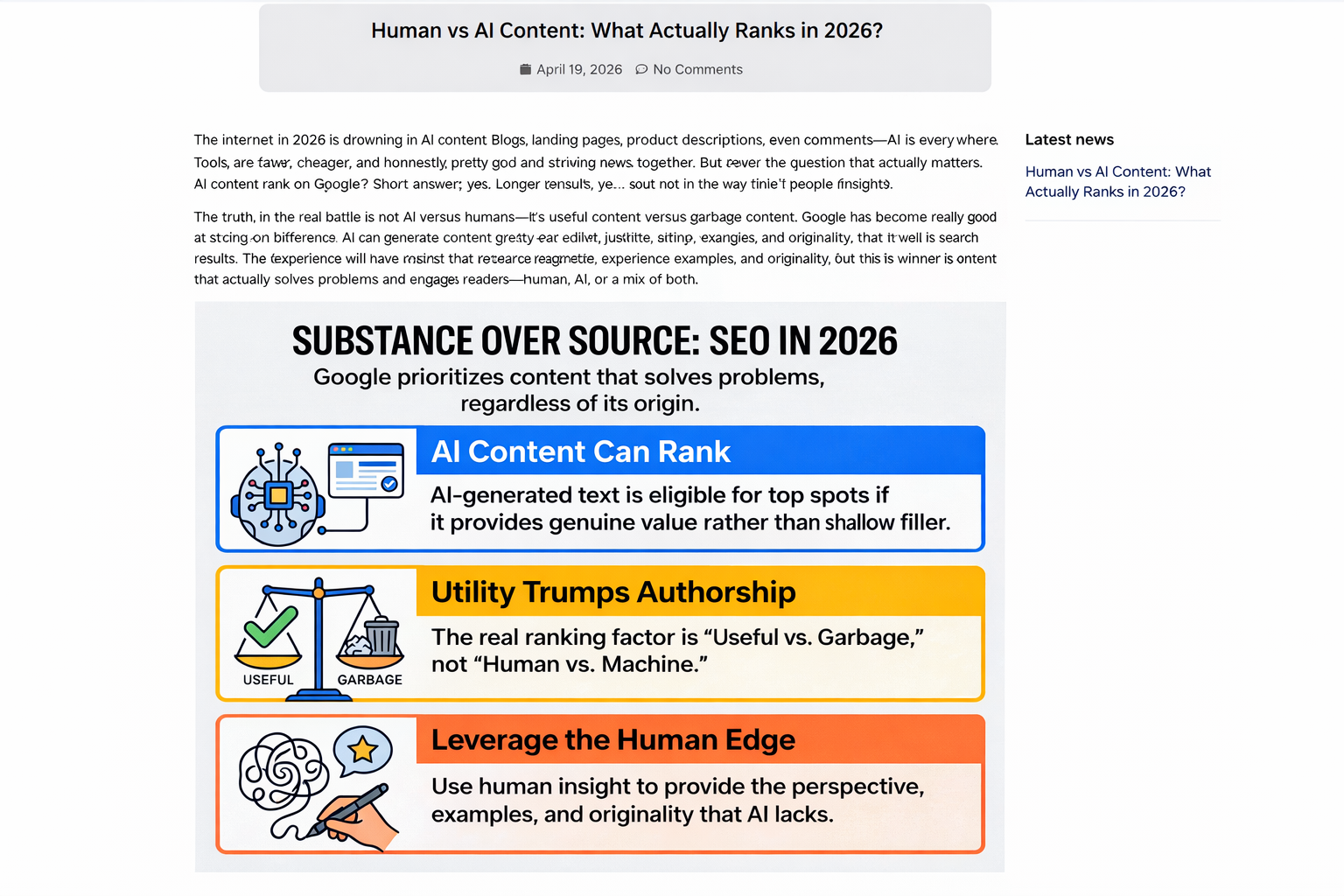
Does AI content rank on Google?
Yes—but only if it’s useful. Raw, unedited AI content usually lacks depth. Human input still makes the difference.
Are backlinks still important?
Yes. But quality matters far more than quantity now. Relevance beats volume.
How long does SEO take to show results?
Typically 3–6 months for noticeable movement. Sometimes longer, depending on competition and consistency.
What is topical authority in SEO?
It means covering a subject deeply and consistently, not just writing one or two posts about it.
Is keyword research still relevant?
Yes, but it’s not the starting point anymore. Intent and context matter more.
How often should I update my content?
Every 3–6 months is a good baseline for important pages. Depends on the topic, honestly.
What is SXO in SEO?
Search Experience Optimization. It combines SEO with user experience—so ranking + usability + engagement.
Can small businesses compete in SEO in 2026?
Yes. Especially with niche focus and high-quality content. Big brands aren’t unbeatable—they’re just consistent.
What is the biggest SEO mistake right now?
Publishing content just to publish. No intent, no depth, no real value. It doesn’t hold up anymore.

Author
Web Winners
Leave a comment
Your email address will not be published. Required fields are marked *